Legal Notice & Reply
A well-drafted legal notice settles a surprising number of disputes without a case ever being filed. A badly drafted one damages your position before you start. We draft notices that carry weight, and we reply to the ones you receive.
What this covers
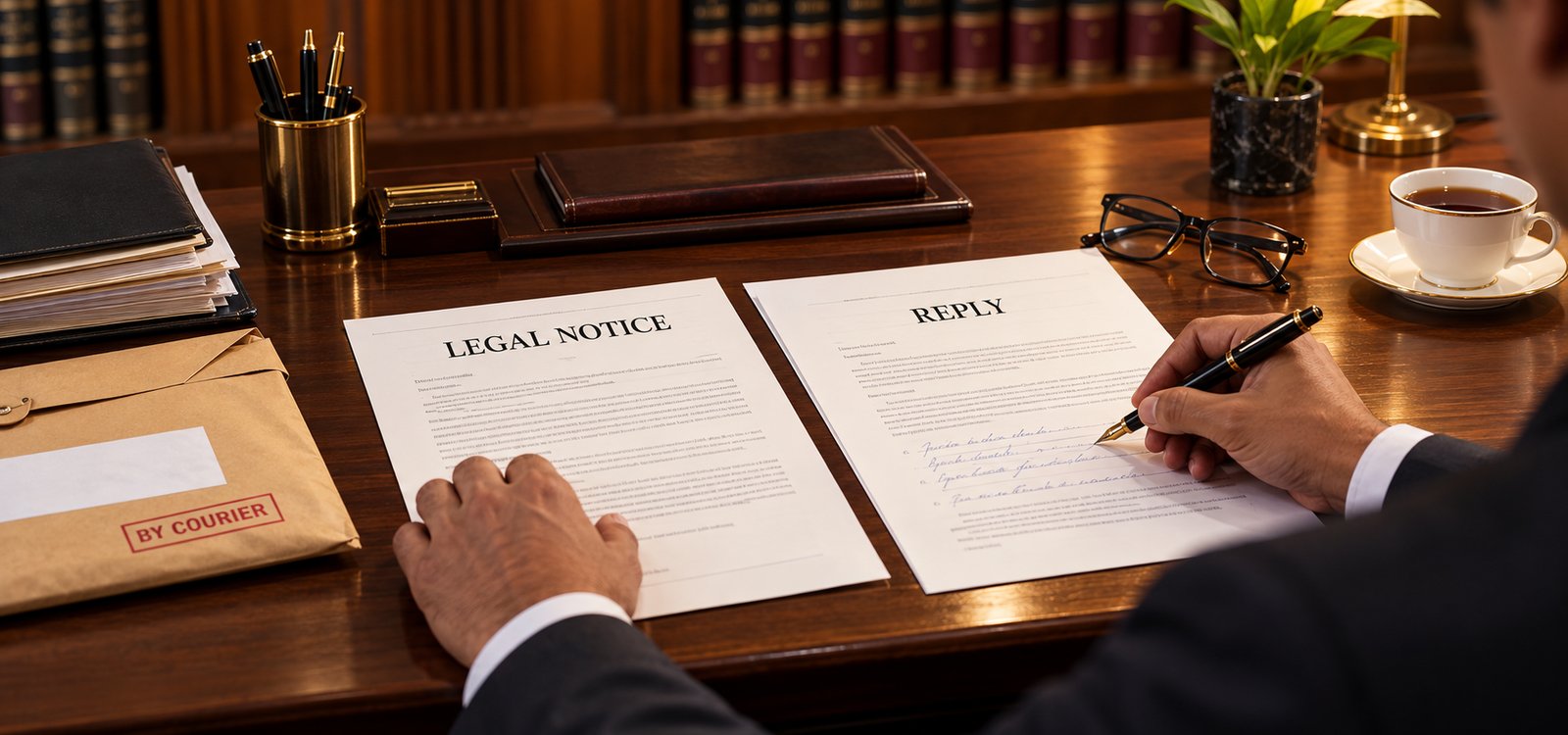
A legal notice states a claim, sets a deadline and puts the other side on record. For some claims it is a legal precondition, notably a cheque dishonour notice; for others it is simply the cheapest way to be taken seriously. We draft notices for recovery, breach of contract, eviction and employment claims, and we draft replies.
Why the drafting matters
A notice is evidence. Every fact you assert, every date and every figure will be quoted back at you in court. A notice that overstates the claim, gets a date wrong or threatens something unlawful weakens the case it was meant to strengthen.
Replying to a notice
Ignoring a notice is rarely wise, because silence gets characterised as admission. A reply is the chance to put your version on record before positions harden, and sometimes to end the matter. We draft replies that protect the position without conceding anything.
What we need
- The contract, invoices or documents behind the claim
- The dates and the amounts, accurately
- What has already been said between the parties
- The outcome you actually want
Timing
A notice can usually be drafted within a day or two, and the notice period itself is typically stated in days. Some claims carry a statutory notice period that must be observed exactly, and getting that wrong can be fatal to the case that follows.
%20scale(0.9)'%20fill%3D'none'%20stroke%3D'%23F1D9A8'%20stroke-width%3D'5'%20stroke-linecap%3D'round'%20stroke-linejoin%3D'round'%3E%3Crect%20x%3D'-100'%20y%3D'-68'%20width%3D'200'%20height%3D'140'%20rx%3D'10'%2F%3E%3Cpath%20d%3D'M-100%2C-58%20L0%2C12%20L100%2C-58'%2F%3E%3Ccircle%20cx%3D'72'%20cy%3D'60'%20r%3D'22'%20fill%3D'%23F8F3EA'%2F%3E%3Ccircle%20cx%3D'72'%20cy%3D'60'%20r%3D'22'%2F%3E%3Cpath%20d%3D'M62%2C60%20l7%2C8%20l15%2C-17'%2F%3E%3C%2Fg%3E%3Ctext%20x%3D'620'%20y%3D'196'%20font-family%3D'Georgia%2Cserif'%20font-size%3D'34'%20fill%3D'%23F8F3EA'%3ESettled%20before%20it%20starts%3C%2Ftext%3E%3Cline%20x1%3D'622'%20y1%3D'222'%20x2%3D'700'%20y2%3D'222'%20stroke%3D'%23B88A44'%20stroke-width%3D'2'%2F%3E%3Ctext%20x%3D'620'%20y%3D'256'%20font-family%3D'Arial%2CHelvetica%2Csans-serif'%20font-size%3D'14'%20letter-spacing%3D'3'%20fill%3D'%23F1D9A8'%3EBD%20ADVOCACY%20%26%23183%3B%20DHAKA%3C%2Ftext%3E%3C%2Fsvg%3E)
Check the claim
We confirm what the claim actually is and whether a notice is required or merely useful.
Draft it precisely
We state the facts, the demand and the deadline in terms you can stand behind in court.
Serve and record
We serve it properly and keep the proof of service the case will need.
Follow through
We take the next step on time, whether that is a suit, a case or a negotiated settlement.
Common questions
Do I have to send a notice before suing?
For some claims yes, and the period must be observed exactly. A cheque dishonour claim is the clearest example. For most other claims it is optional but often worth it.
I received a notice. Should I reply?
Usually yes. Silence tends to be read as acceptance, and a reply is your chance to put your version on record before positions harden.
Does a notice have to come from a lawyer?
Not strictly, but one drafted by an advocate is taken more seriously and, more importantly, is drafted so it does not damage your case later.
Send, or answer, a legal notice
Drafted so it helps the case rather than harming it.